At Monet's Table

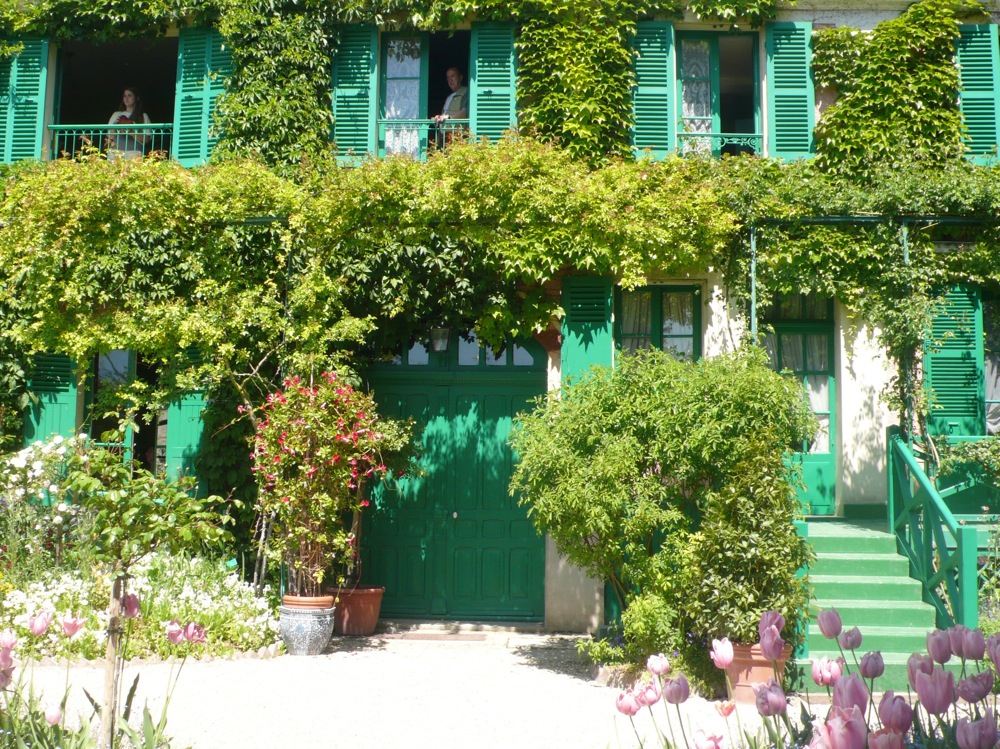
The daily lives of the impressionist painters were very much on display in their work.  The subjects they chose - family, friends, domestic scenes - give us a glimpse of French middle-class society near end of the 19th century.   Only rarely are we able to view an artist's private life as if we were family.  The carefully crafted world Claude Monet created at Giverny is one such splendid example.

giverny


Before you visit, I recommend you read the short memoir of life at Giverny described in Monet’s Table.  (The author, Claire Joyes, is the wife of Mme. Monet’s great-grandson.) There you discover that Monet kept cooking journals and directed a two acre kitchen garden.   Today, he would be called a ‘foodie’ although I prefer the French word, gourmand.

BANANA SEASON IN TUCUMCARI, NEW MEXICO

Del’s diner is easy to find on old Route 66 in the middle of Tucumcari, New Mexico.  Just look for the restaurant with the larger-than-life plaster steer on the roof.  And don’t expect it to be Zagat-rated.

George and I sat down for breakfast at Del’s on a cold February morning just two days drive from our point of departure in warm sunny Malibu   Our sentimental drive to Chicago on Route 66 included eating meals at original diners on the road.

My order of oatmeal arrived with milk and a skimpy pile of raisins in a paper cup.   Something was missing.  “Do you have a banana?” I ask. ‘I’ll check,” said the waitress.  She was back in a nanosecond.  “Sorry.” she reported, “We only carry fruit in season.”

We got it.  We had left 2005 (real time) and entered Del’s, time warp where it will always be1956, the year they opened.  Back then, bananas were an exotic fruit.  Today we eat more bananas than apples and oranges combined!  They are grown in tropical zones around the globe.

I recalled my banana-less breakfast at Del’s as I read in The New Yorker that the banana may again become a rarity.  A soil-borne fungus, with the unlikely name of Tropical Race Four, has wiped out banana farming in Asia, the Philippines and Australia.  Experts predict it will spread to Latin American, the source of all American banana imports.  Like some subterranean villain in a horror flick, the fungus is resistant to all the agrichemicals in our arsenal.  Yes, soon we may have no bananas.

If and when this collapse occurs, it won’t be the first time.  Banana farming has always depended on a monoculture.  The current top banana, the Cavendish, replaced the reportedly delectable Gros Michel. The latter was wiped out by Race One, a cousin of the current blight.

There are as many as a thousand banana varieties in the wild waiting to be discovered and domesticated.  Contestants must be sweet, tender, slow to ripen and be covered with a skin that resists bruising.   At the same time scientists are working to create a gene they can insert in the Cavendish, Gros Michel or any other tasty variety to make them resistant to both Race One and Tropical Race Four.  My advice: eat your bananas now, while they are plentiful, cheap and in season.

Links to two popular banana desserts from the archives of Chez Madelaine follow.  In addition, I offer a Banana and Bittersweet Chocolate Jam adapted from a recipe of Christine Ferber, the French queen of confiture.

The article I have referred to throughout this blog is from The New Yorker, January 10, 2011. http://www.newyorker.com/reporting/2011/01/10/110110fa_fact_peed

Bananas Foster http://www.chezm.com/welcome-to-recipes/47-desserts/399-bananas-foster

Spicy Baked Bananas: http://www.chezm.com/welcome-to-recipes/47-desserts/180-spicy-baked-bananas

BANANA AND DARK CHOCOLATE JAM

Ingredients for 2 cups:

2 medium bananas, perfectly ripe (1 1/4 cups sliced)

1/3 cup cool water

1 1/4 cups  sugar

1/2 tablespoon lemon juice

3 ounces dark chocolate, chopped

Directions:

  • Combine the banana slices, cut about 1/2 “ thick, water, sugar and lemon juice in a heavy pan.  Bring to a simmer, stirring to dissolve the sugar.
  • Off the heat, add the chocolate, cover the pot and let stand for 5 minutes.
  • Return the pan to medium heat, and bring the mixture to a simmer, stirring continuously.  Continue to cook and stir frequently for 5 minutes as the jam thickens.  Skim any foam that forms from the surface.
  • Pour into a clean jar, let it cool to room temperature, cover tightly and keep refrigerated.
Best Baguette

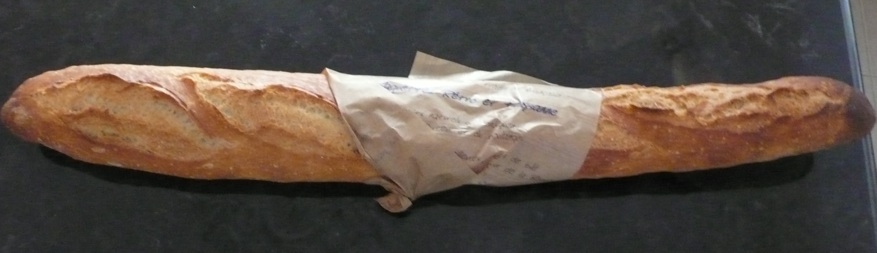
Only in France can a simple baguette cause the kind of controversy that arose in Paris this spring.  Bread, if  you weren’t already aware,  is a very big deal in this food-obsessed country.  Marie Antoinette found this out to her detriment in the 18th century.  When told that a bread shortage was behind gathering mobs of angry Parisians she responded, “let them eat cake”.

baguette

BETTER BUTTER

steak1


The alarmingly large selection of outdoor grills on display at our local hardware store convinced me. There must be one out there for every American with a backyard. Those nostalgic for a ’50’s Sputnik look can still purchase the original round black Weber model.  The largest ones ones are designed to be the same size as the owner’s SUV - gas powered, stainless steel and fitted with a refrigerator and sink.  Who needs to cook indoors?

BIG FISH STORIES

The labels in the seafood section of our markets tell some unbelievable fish stories these days. At Whole Foods Chilean sea bass is identified as both wild-caught and of US origin.  Atlantic salmon at Jewel stores sells for $5 a pound at Jewel stores while a sign overhead claims support for sustainably raised seafood.  An engaged consumer can tell there’s something fishy going on   


It turns out that the Chilean Sea Bass was wild-caught somewhere and shipped frozen in the States.  Defrosting it for sale apparently makes it an American product.  It stretches credibility to believe that salmon farmed in ocean pens hundreds of miles offshore and in foreign countries can be responsibly raised and sold for $5 a pound.  The sad truth is that upwards of  80% of America’s seafood is imported.  Some of it makes a round-trip from the States to processing plants abroad where labor is cheaper and returned here frozen. That’s one fish story we are not likely to be told unless we ask. 


The affordable salmon we see year round in our supermarkets is Atlantic salmon, now extinct in the wild and raised exclusively in offshore pens.  A decade ago, the World Wildlife Fund published environmental and public safety standards for farmed salmon In a  2018 post, I reported that the non-profit Aquaculture Stewardship Council had assumed the role of certifying fish farms that complied with these practices.   A blue ASC logo displayed at the grocery store was like a Good Housekeeping seal of approval for seafood. 


This consumer security blanket was abruptly pulled away last year with the release of the Netflix documentary, SeaspiracyThis film recorded the appalling extent to which fishing industry practices are responsible for decimating fishing populations, polluting waters around the globe with debris and abusing its poorly paid workforce.  The film also exposed the certification system as a pay-to-play industry sham.  The public remains currently at sea when it comes to evaluating the quality of seafood for sale in the marketplace.   


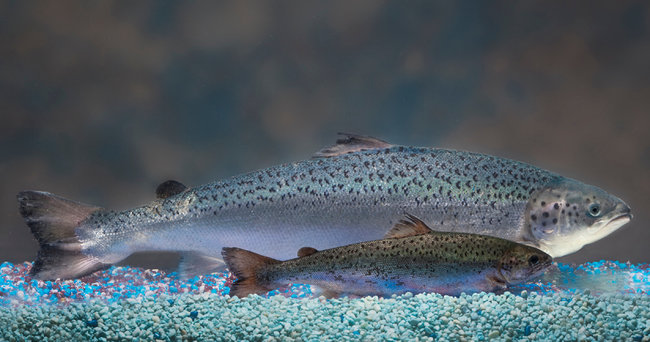
For a  story about what we can expect in the future, let’s return to the 2012 post I wrote about a company awaiting final FDA approval to farm a genetically-altered salmon.  Thirty years ago   Aquabounty inserted two genes from other fish species in an Atlantic salmon that allows it mature much faster and to grow exponentially larger than the standard Atlantic salmon (see the photo at the head of this post). When  I reported the AquaBounty story, the company had been waiting for ten years for approval.  It was running out of money and about to be sold. 


I followed up on this cliffhanger story for this post.  Not only is Aquabounty alive and well, the company is raising its salmon in my backyard, so to speak.  Its two midwestern facilities raise salmon in large indoor ponds that clean and recirculate water.  This hydroponic model is sustainability at its best, but questions do remain.  Will the public purchase and eat a fish-not-found-in-nature?  Does it taste just like or better than other farmed salmon on a diet of manufactured food pellets that look like dog food?    


My advice going forward is to confirm the source and freshness of the seafood you purchase.   Store employees should be able to tell you where a fish was caught, whether it is wild or farmed and if it arrived frozen.  In my experience, the staff is quite helpful and will retrieve the box a fish arrived in to answer your questions.  I will continue on the lookout for the next fish story.