When Chicago shuts down, as it did this past Sunday morning under a foot-deep blanket of snow, there's only one recourse. Get out the cast-iron skillet and prepare a hearty winter breakfast. At our house, that means Eggs Benedict.
When you love breakfast, you always have the essential ingredients, in case, for example, you should want to have breakfast at dinnertime. I'm serious. Supplies include English muffins (in the freezer), thick sliced bacon, eggs and Hollandaise sauce. What? You don't have a jar of Hollandaise next to the mayo in the door of your refrigerator? It's time to remedy that situation
Leftover Hollandaise, like mayonnaise can be safely stored in the refrigerator from week to week. When you want to restore it to a rich, coating consistency, simply whisk it tablespoon by tablespoon, off the heat, into a hot tablespoon of whipping cream and lemon juice. Want a thicker sauce? Whisk in melted butter after the cold sauce, adjust the seasonings and Voila! The Hollandaise sauce is ready faster than you can poach an egg.
Of course, you have to make sauce Hollandaise first. In terms of technique, making Hollandaise is very much like making mayonnaise, with the addition of heat. Both sauces start with yolks beaten with vinegar or lemon juice into which oil in the case of mayonnaise or butter with Hollandaise is slowly added. An illustrated description follows:
HOLLANDAISE SAUCE
Four Servings:
1 large egg yolk at room temperature
1 teaspoon cool water
1 teaspoon lemon juice
1/4 teaspoon sea salt
2 tablespoons cold unsalted butter
5 tablespoons unsalted butter, melted
Additional lemon juice
Freshly ground white pepper
Garnish: Freshly chopped chives
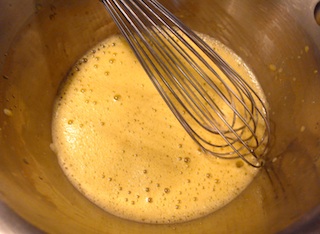
Fig. 1: Combine and whisk the yolk, water, lemon juice and salt until frothy. Whisk in two tablespoons cold butter, one at a time, with the pan over low heat. Continue warming this mixture until the bottom of the pan can be seen with each whisking motion. The liquid should lightly coat the bottom and sides of the pan. Off the heat, gradually whisk in the melted butter. Season to taste with more lemon juice and freshly ground white pepper.
Hold the sauce in a hot water bath (100 degrees) for 2-3 hours, or in a thermos for 6 hours.
Leftover Hollandaise will break if it's warmed directly over heat, but the chilled sauce can be whisked back to life by adding it to a little bit of cream and lemon juice. (A broken mayonnaise can be whisked back into an emulsified state by adding it slowly to a teaspoon each of mustard and vinegar,) Any sauce remaining after serving this reincarnation goes back into the refrigerator, awaiting its next use. With repeated heatings the proportion of egg yolk to butter in the sauce diminishes. You can reverse that process by using the cold leftovers to start the next recipe of Hollandaise.
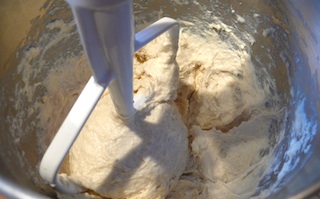
Link to English Muffin Recipe
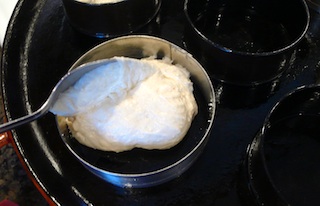
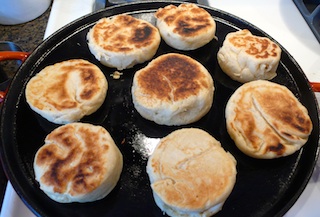
Those of us who dote on breakfast take advantage of the leisurely pace of a snowed-in Sunday morning to make English muffins. The dough requires a minimum of staple ingredients (flour, water, yeast and salt) and rises in one hour. Muffins cook quickly on a hot griddle, dropped in free-form rounds or spread in metal hoops (or repurposed tuna fish cans). Check to see they reach the internal temperature of 200 degrees on instant-read thermometer.
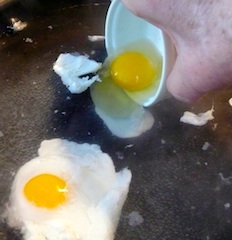
When it's time to poach the eggs, I add a teaspoon of salt and a tablespoon of white vinegar to boiling water in an eight inch skillet. Instead of breaking them directly into the water, I open each egg into a ramekin and gently pour them into the water. An offset spatula or fork comes in handy at this point to release the egg from the bottom of the pan.
A plate of Eggs Benedict calls for a side of bacon, either Canadian bacon, thick-sliced applewood smoked bacon, even duck bacon (Maple Leaf Farms). For Mardi Gras, I will be serving poached eggs and Hollandaise sauce over large crab cakes (see below).. When spring finally arrives, there will be Hollandaise for asparagus and salmon. I could go on, but it's starting to snow again. Time to reach for my skillet.
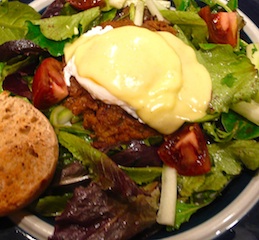
Mardi Gras Eggs with Hollandaise on a Crabcake
FYI: I will be teaching these recipes and more in late May at the Alliance Francaise de Chicago. Look for details this spring on the Home page of www.chezM.com or the Alliance Francaise.