STAY-AT-HOME LEEK AND POTATO SOUP

The stay-at-home lifestyle has elevated dinnertime to high point of the day, if it wasn't already.  Say you have shopped just once a week during the last three weeks of confinement.  The makings of a simple, satisfying meal can be within reach.  It is as easy as returning to roots.  

You are forgiven for passing over root vegetables in the produce aisle.  They have zero eye appeal. What they lack in color and seasonality they make up for in the nutrients they have absorbed underground and fiber.  Roots are also loaded with starch which we break down into glucose.  Yes, eating root vegetables will give you a legal culinary high.

My favorite root recipe is a comforting soup of leeks and potatoes.   In France they call it Potage Parisien and treat it as if it were the little black dress of the culinary world.  First they swap out water for chicken broth and then proceed to dress it up with watercress, herbs or lettuce. 

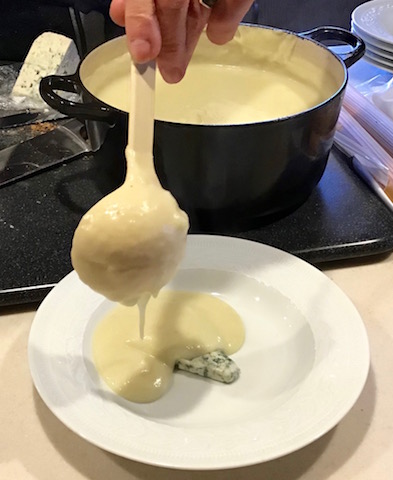
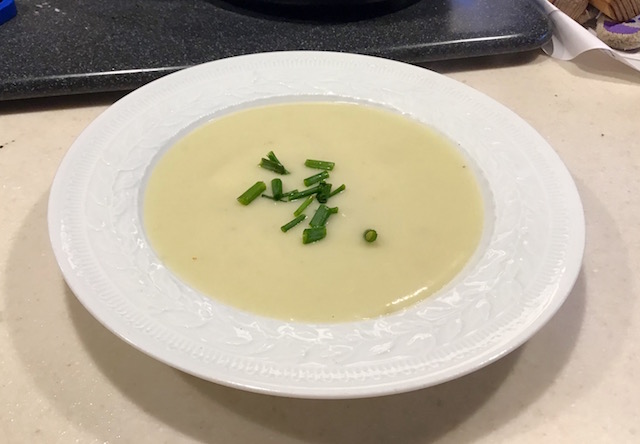
I prefer to surprise guests by placing a thin slice of blue cheese in the bottom of the soup bowl.  The cheese is hidden, waiting to be discovered after the hot vegetable puree is poured over it.  A garnish of fresh chives adds the comforting green aroma of Spring.   

If you are not a fan of blue cheese, substitute another variety that melts easily, or grate a hard cheese into the bowl.  The point is to swirl the cheese into the soup as you consume it.  Each spoonful tastes a little different than the one before which accelerates the process.  You're soon ready for another helping. 
  

POTAGE PARISIEN (LEEK AND POTATO SOUP)

 Ingredients for 6 - 8 servings

4 tablespoons unsalted butter

3 cups thinly sliced leeks

4 cups peeled and cubed russet potatoes 

4 cups cool water

1 teaspoon kosher salt

freshly ground white pepper, to taste

1/2 cup whipping cream

3 ounces blue cheese

Garnish: 2 tablespoon minced fresh chives 

Melt the butter in a heavy 4 quart pot.  Cut the leeks 1” into the green portion.  Trim the root end and quarter the leeks lengthwise without separating them at the root end.  Rinse the interior of the leek leaves to remove any dirt.  Thinly slice and add them to the hot butter, stirring and cooking for 5 minutes as they soften.

Peel, quarter and cut the potatoes into 1” cubes.  Add them to the leeks and continue cooking for another 2 -3 minutes.  Pour in the water, bring the liquid to a boil and simmer, partially covered, for 15 minutes, or until the potatoes are tender.

Puree the soup with an immersion blender, season with salt and pepper.  Stir in the cream and thin with water, if desired.  Place a slice of cheese at the bottom of each soup bowl.  Pour on the soup.  Garnish with fresh chives, and serve immediately.



STAY-AT-HOME LEMON BREAD PUDDING WITH DRIED CRANBERRIES

It’s been said that the only way to benefit from a lemon is to to add sugar.  That’s a bum rap.  The lemon is sour, to be sure, and often seedy.  It is also is as indispensable in the kitchen as a knife.  The lemon’s very tartness can bestow greatness on any number of sweet and savory dishes.

Classes devoted to lemon recipes have been perennial favorites over the years.  We prepare recipes in which the lemon is a key ingredient even when it has a bit part.  Just a spoonful of lemon juice can intensify bland flavors,  serve as a salt replacement, or reduce sweetness in a recipe.  We also explore the importance of lemon’s acidity as a preservative and tenderizer before refrigeration.  The distinctive way lemons preserved in salt flavor Moroccan cuisine is also a taste legacy from a time when citrus fruits arrived on Silk Road caravans from Asia.

The flavor of lemon is most addictive as a rich golden curd, a thick custard of eggs, sugar, butter and lemon juice.  Here, the inclusion of grated lemon zest with its intoxicating aroma of tropical fruit is essential.  I can’t resist using lemon curd to give a tart jolt to comforting but overly sweet English nursery desserts such as trifle and bread pudding. 

Let me caution you that my technique for preparing lemon curd demands your focused attention.  I combine close observation and a digital thermometer to prepare curd in a fraction of the time it takes in a double boiler.  Follow the detailed directions and lower the temperature under the pan to your comfort level.  Straining the curd after it thickens will remove the zest and any 'boo-boos' if the eggs have started to scramble.  If you want to avoid the stress, prepare the curd over hot water in a double boiler and take your time.  Nobody’s watching.

LEMON BREAD PUDDING WITH DRIED CRANBERRIES

 Ingredients for 8 to 10 servings:

1 pound day old loaf of French bread

Lemon Curd

2 large eggs

2 large egg yolks

3/4 cup sugar

1/2 cup lemon juice

grated zest of 2 lemons

1 stick unsalted butter, cut into 8 pieces

Custard:

2 cups milk

3 large eggs

1/3 cup sugar

1/4 teaspoon salt

3/4 teaspoon vanilla extract

Garnish: 2/3 cup dried cranberries or cherries

Preheat the oven to 350 degrees.  Generously butter a 2 quart baking dish or bread pan.  Trim crust from the bread, if desired, and slice evenly. 

Lemon Curd: Warm the eggs, yolks, and sugar in a heavy saucepan to 100 degrees whisking continuously.  Add the lemon juice, zest and butter, and cook over medium low heat using a spatula to continuously clean off the bottom and sides of the pan.  Monitor the temperature of the curd as it begins to coat the sides of the pan.  It is thick enough when a digital thermometer reads between 160-170 degrees.  Strain the curd into a bowl.  Cover its surface with plastic wrap to avoid a skin from forming.

Custard and assembly:  Whisk together all the custard ingredients until the mixture is homogeneous.  Determine the number of pudding layers looking at the thickness of the bread slices and the depth or circumference of your container.  Make 3 -5  successive layers of bread, custard, curd and cranberries ending with curd and cranberries.  Let the pudding stand for 5 - 10 minutes so the bread has time to absorb the custard.  After 15 minutes, run a knife around a pan, reverse pudding onto wax paper and turn upright on a serving platter for slicing.  Serve directly from a bowl either warm or at room temperature.

STAY-AT-HOME LENTIL, HAZELNUT AND AVOCADO SALAD

A new crop of cookbooks is being written during this period of social isolation. Next year we are likely to see titles like Cooking in the Time of Pandemic and The Can Opener Cookbook for sale on Amazon.  Unlike Depression era cookbook recipes that coaxed flavor from basic provisions, these will champion creative ways to live comfortably with less.  

Six weeks ago I could shop daily for whatever foods caught my fancy at that moment. Now I shop once a week, as I did when my children were young, but I go out early in the morning wearing a mask and nitrile gloves. Rather than purchasing ingredients for two or three different recipes, I purchase for one recipe based on a grain, legume or rice.  I cook a large quantity and serve it with variations several times during the week.

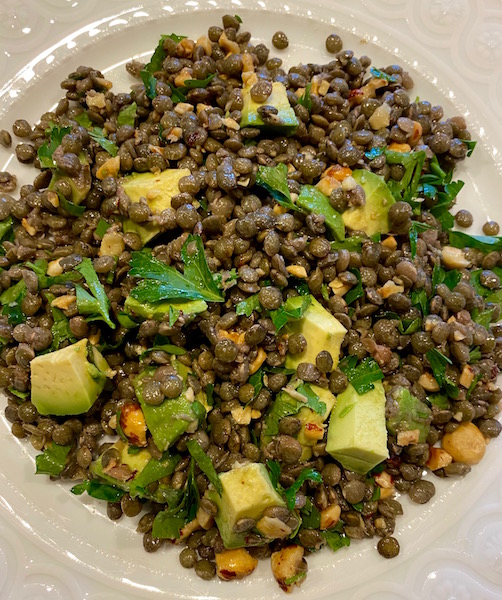
One of my favorite choices is a lentil salad that offers many sensuous pleasures. For best results, I purchase deep green lentils from France or an organic variety. (Lentils previously sold in bulk are currently packed in plastic containers at Whole Foods; Jewel sells green lentils in boxes.) Unlike colored dals and split peas, lentils are a legume with a tough outer skin that when cooked, al dente, pop gently in your mouth as their skins burst.

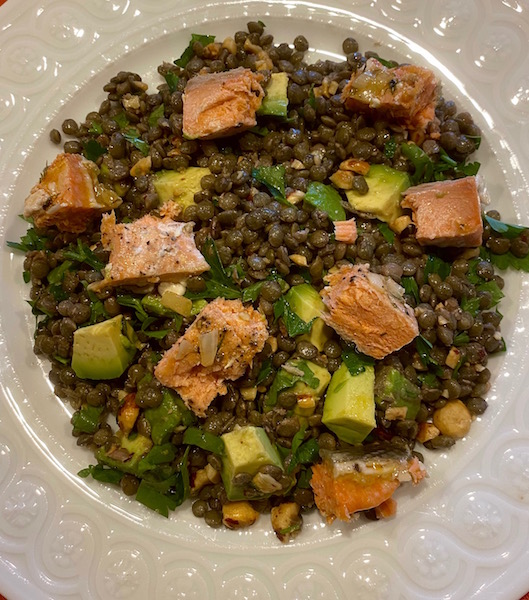
The other ingredients offer flavor and texture accents: the caramel fragrance and crunch of toasted hazelnuts, creamy chunks of avocado, a tart lemon vinaigrette for contrast and palate-cleansing parsley leaves. This low-key harmony of flavors welcomes a topping of crumbled feta, cubes of cold salmon or steamed mussels.  I'm sure you have something in your refrigerator that will work. 

LENTIL, HAZELNUT AND AVOCADO SALAD

Ingredients for 3 - 4 servings:

1 cup of green lentils (lentilles de Puy preferred)

1 clove garlic, smashed and peeled

1/2 cup hazelnuts

2 tablespoons lemon juice

1/2 teaspoon Dijon mustard

1/3 cup olive oil

Sea salt and freshly ground black pepper

1 avocado

1/3 cup Italian parsley leaves, coarsely chopped

Rinse and pick over the lentils. Combine them with 2 cups water and the garlic in a saucepan. Bring liquid to a simmer and simmer, partially covered, until the lentils are just tender, about 15 minutes. Drain remaining liquid, remove the garlic and reserve.

Preheat the oven to 375 degrees. Toast the hazelnuts in the oven for 5 - 10 minutes. While they are still warm, rub off as much brown skin as will come off easily in a towel. Coarsely chop them and reserve.

Make a vinaigrette by whisking lemon juice with mustard and slowly adding olive oil. Taste for balance and add salt and pepper, to taste.

Cut an avocado in half vertically tracing the knife around the seed in the center. Twist the halves apart and remove the seed by impaling it on the knife (gently) and twisting it out. Cut vertical slices in the fruit without cutting through the peel and release them by running a spoon between the flesh and the peel.

Fold the hazelnuts and avocado into the lentils.  Blend in the vinaigrette and parsley.


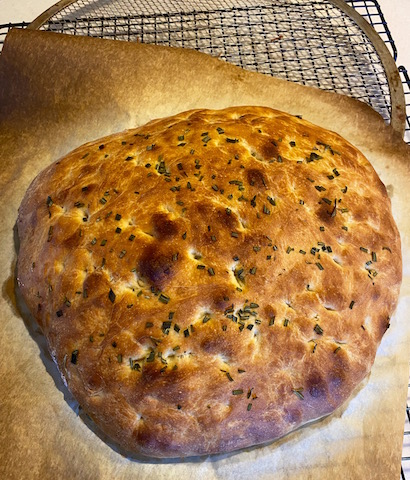
STAY-AT-HOME NO-KNEAD FOCACCIA

Home cooks are constantly searching for their next culinary ‘fix’,  be it an update of a familiar dish or an exotic recipe from another part of the world.  Our kitchens counters are littered with time-saving equipment that deliver perfectly whipped egg whites, pureed pistou, and foam-capped espresso.  Rarely does a recipe achieve worldwide acclaim with four ingredients, untended rests and a hot oven  

Such was the seismic response by home cooks to Jim Lahey’s No-Knead Boule recipe in The New York Times Good Eating section in November 2006.  Lahey’s recipe contains less yeast, more water with a consistency easily mixed by hand.  The dough rises slowly at room temperature and then is refrigerated overnight or longer.   Still too soft to knead, the baker simply turns it into a Dutch oven to bake when desired.   The result is an expanded round of flavorful bread, with a light, chewy texture and crisp, brown crust.  How could a dough that requires so little labor and is so amenable to the baker’s schedule make such terrific bread?

The chemistry is as basic as it is compelling.  A long rise allows yeast to proliferate as it feeds on the flour’s incomplete starch and sugar.  Yeast activity produces alcohol and carbon dioxide which is trapped in the flour’s gluten strands causing the dough to rise.  Home bakers have always kneaded dough to develop its gluten.  Little did we suspect that the dough will structure gluten naturally in a wet dough given enough time.  Home bakers who relied on kneading to work out their frustrations are encouraged to join a gym.

Several books, including one by Jim Lahey, have expanded the No-Knead technique to a wide variety of breads. The recipe that Catherine Damme sent me contains a little olive oil to aid in stretching the dough into flatbreads for focaccia and pizza.  Unlike the original boule recipe which is baked in kettle, this dough can be assembled in the morning and baked in the afternoon for dinner.  Our current stay-at-home condition offers first time and experienced bread bakers an unrivaled opportunity to work ‘the staff of life’ into their daily routine.  


NO-KNEAD OLIVE OIL DOUGH 

Ingredients for 1 large loaf

3 3/4 cups unbleached white flour

1/2 tablespoon instant yeast

2 teaspoons kosher salt

1 tablespoon sugar

1 2/3 cup water (at 100 degrees)

2 tablespoons olive oil

Focaccia:

2 tablespoons olive oil 

1 teaspoon minced fresh rosemary 

Mix the flour, yeast, salt and sugar together in a large bowl.   Make a well in the center and pour in the water and olive oil.  Work the dry into the wet ingredients to form a rough dough.  Transfer the dough to another bowl that has been brushed with olive oil.  Cover the bowl with plastic wrap, and leave in a sheltered place for 2 hours.  Transfer the bowl to the refrigerator for 3 hours to firm it.  

Remove the bowl from the refrigerator, place a pizza stone in the oven, and turn the temperature to 475 degrees.  Lightly dust a circle on a piece of parchment.  Scrape the dough onto the floured parchment and lightly flour the surface of the dough.  Working with floured finger, smooth and stretch the dough into a 14”  round.  Allow the dough to rest for 20 minutes as the oven heats.  

Poke to the bottom of the dough with fingers to create a pattern of holes. Brush on the olive oil and scatter on the rosemary.  Slide the parchment onto a pizza screen or a cookie sheet.  Place the focaccia on the stone and turn up the oven to 500 degrees.  Bake for 15 - 20 minutes until the bread is golden brown.  Remove the bread and slide it off the parchment onto a cooling rack.  Cut when warm or at room temperature.

 ASPARAGUS WITH LEMON VINAIGRETTE AND CHOPPED  KALAMATA OLIVES


STAY-AT-HOME PASTA WITH OLIVES AND CAPERS


We are nearing the end of our second week in virtually lock-down conditions with no end in sight.  New restrictions in Chicagoland limit access to large public parks, golf courses and playgrounds. Are we completely protected from contact with the coronavirus?  Not quite. 

The supermarket, that last remaining arena of social contact, is coming under closer  scrutiny.  Food ingredients themselves are not the likely vectors for disease.  Transmission risks lie on surfaces other people have touched including food containers and, of course, fellow shoppers themselves.  Here is a list of good practices I've assembled to help you minimize risks when shoppping:  

  • Only shop once a week. (That has to be the hardest one to follow)
  • Pull on nitrile gloves before entering the market. Discard them before returning to the car.
  • Wipe off the handle of the shopping cart with the sanitizing wipes provided at the door. 
  • Practice six foot distancing from others while shopping.
  • Give purchases a sanitizing wipe when unpacking home. 

Finally, we are ready to cook!

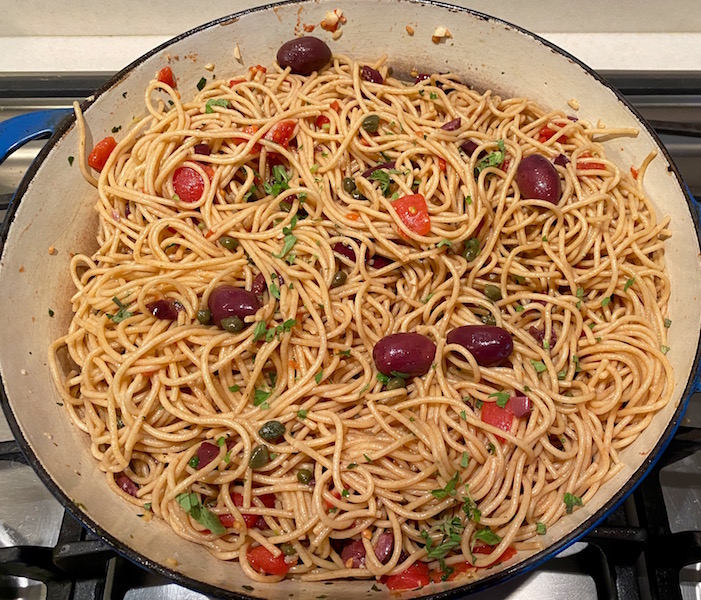
I am delighted to pass along an easy pasta recipe sent in by long-time blog reader Nancy Cunov. All of us stay-at-home cooks long for a sauce packed with the ripe Mediterranean flavors of tomatoes, olives and capers. This is a satisfying dish hiding in plain sight. Most of the ingredients are already in your refrigerator or pantry. Preparation time is minimal. How hard is it to open a can?   

Nancy added one sentence of directions with the list of ingredients for this recipe.  You are allowed to do that when you’re Italian.  Making sauce for pasta is coded in your DNA.  The rest of us need a little guidance which I’m happy to contribute.  Thank you so much, Nancy!

WHOLE WHEAT SPAGHETTI WITH TOMATOES, OLIVES AND CAPERS

1 pound spaghetti (Terra Bona whole wheat, preferred)

1 cup pasta cooking water

2 tablespoons olive oil 

1 clove garlic (or more), minced

1 cup canned diced tomatoes 

1/2 cup chopped black olives (kalamata)

2 heaping tablespoons capers (packed in vinegar)

1/2 teaspoon kosher salt, ground pepper to taste

2 tablespoons fresh basil or oregano, finely chopped OR 2 teaspoons dried

Cook the pasta in 4 quarts boiling water with a tablespoon of kosher salt to an al dente consistency  Ladle out and reserve a cup of cooking water before draining the pasta.  Turn the pasta into bowl and toss with 1 tablespoon olive oil.  Reserve.

Saute the garlic pieces in the remaining tablespoon olive oil for 1 minute in a deep skillet.  Stir in the tomatoes and cook for 2 -3 minutes as the tomatoes render their juices.  (If you are using dried herbs, stir them in now.)  Add the pasta and toss until well mixed.  Pour in as much pasta cooking water as needed to distribute the tomatoes and lubricate the pasta. Fold in the olive pieces and capers; continue cooking and folding until all the ingredients are heated through.  Add salt and grind on pepper, to taste.  Stir in the fresh herbs and cook another 30 seconds.  Garnish with additional whole olives and serve.

Please continue to send me your stay-at-home recipes.  We’re in this together!