We made quick trip to visit friends in London and check out the dining scene last week. It's an easy commute, really. After just two-and-a-half comfortable hours on the Eurostar tunnel train, we arrived in bustling central London expecting a smooth segue into a familiar culture. We speak the same language, share a great deal of history, therefore, we know what to expect from English food, right? Wrong! We were treated to wildly different dining experiences as unexpected as Monty Python skits - and just as much fun.
Our first dining stop was lunch at Abeno, the only okonomi-yaki restaurant outside of Japan. (Except for a second location in central London.) Okonomi-yaki is a traditional comfort food in Osaka: a light pancake of egg, minced cabbage, ginger and green onions, bound in a light batter and cooked on a hot griddle at the table. Variations on this formula include a cooked meat, fish or poultry filling.
Okonomi-yaki is obviously not of what we have come to think of in the States as teppan-yaki cooking where diners are entertained table-side by chefs wielding knives. The intimate dining we experienced could only have been inspired by a homesick native. Okonomi-yaki is a 400 year-old dish, but it's not serious dining. At Abeno it is garnished with concentric rings of Japanese mayo, Worchestershire, pickled ginger and powdered algae, just like a Chicago hot dog!
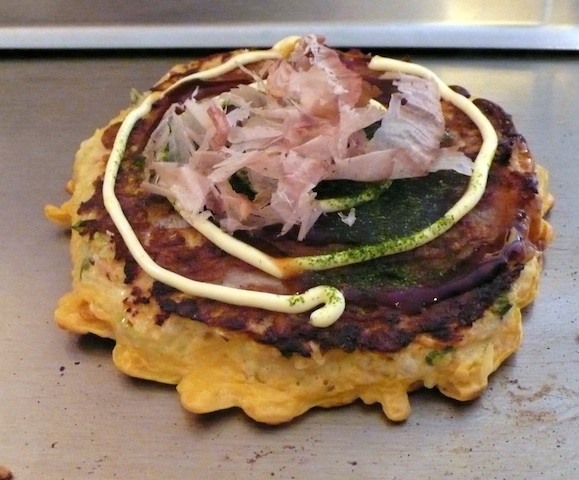
Much of our meal at Abeno was traditional in the sense that we were served miso soup and a refreshing seaweed and cucumber salad as we watched our orders prepared by the waitress. She followed a ritual, first browning one side of the cake, adding a sauteed filling, more batter, then turning it to cook on the other side. Dome-shaped lids were used to cover the cakes from time thus ensuring they would be cooked through without drying out the surfaces.
Abeno also seeks to accommodate an upscale Western clientele. The restaurant uses organic ingredients, offers an intriguing list of wines as well as beer and tea, plus press-pot coffee at the end of the meal. We left feeling refreshed and primed for an afternoon visit to the nearby British Museum.
Our destination for lunch the next day was Heston Blumenthal's newest restaurant called, simply, Dinner. We passed through the Renaissance mausoleum-like lobby of the Mandarin Oriental into its antithesis, an open airy dining space. A bank of windows on one wall overlooks the broad expanse of Hyde Park. The kitchen is surrounded floor to ceiling by glass as is the extensive wine collection. In this transparent, modern setting and equipped with the latest technology micro-gastronomy has to offer, Blumenthal serves dishes based on historic English recipes. Are you with me?
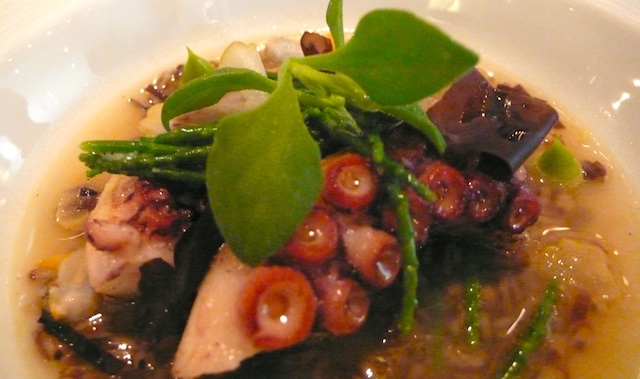
I rose to the challenge by ordering frumenty, a medieval dish of crushed wheat cooked in milk. A recipe for this porridge appears in the first English cookbook from the time of King Richard II (1390). One simple version of fromenty was served with venison; another included cooked porpoise. I could not have made this up! And the Blumenthal version? A bowl arrived with two succulent octopus tentacles in a smoky fish broth with sea pickles (dulse), tiny cockles (clams) tender wheat berries and lovage. It was remarkably full of nuanced seafood flavors and a pleasure to eat.
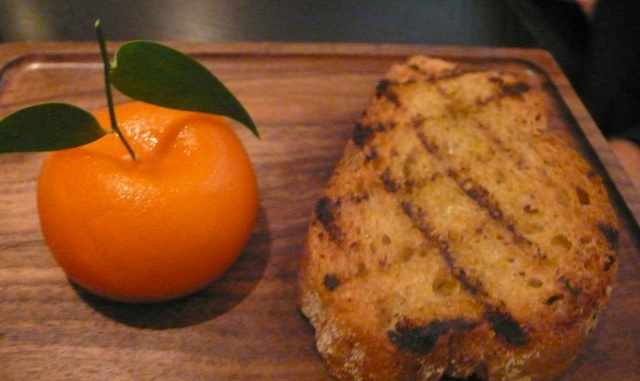
George’s order of ‘meat fruit’ appeared to be a tangerine served on a wooden plank with a with a grilled slice of bread. The fruit peel was actually a soft mandarin-flavored gel coating a delicious mousse of chicken liver and foie gras at just the perfect consistency to be spread on bread. This kind of clever conceit was not unusual in 16th century court dining. One wonders how it was accomplished without modern silicone molds and powdered agar-agar. Will Blumenthal next recreate blackbirds in a pie or stuff a peacock?
There can’t be many well-heeled London tourists intrigued by forays into food history. Dining on 'nettle porridge' is not something you brag about back home. In fact, I spied metal cups filled with french fries pass by our table on trays throughout the meal. Wait a minute! What was a Belgian invention doing here? There, at the bottom of the à la carte menu, I found three premium beef preparations, all given respectable historic pedigrees, and all served with french fries and ketchup.
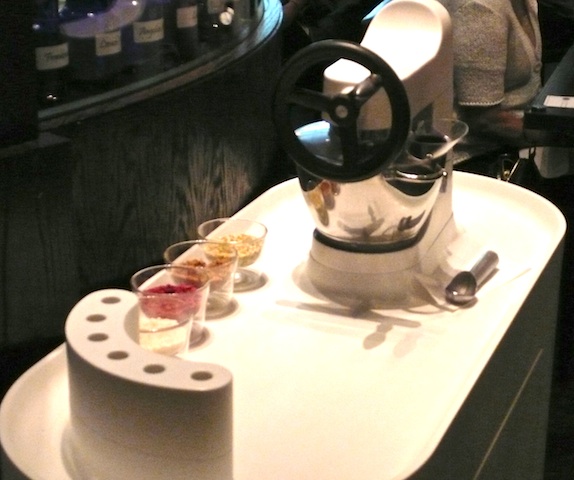
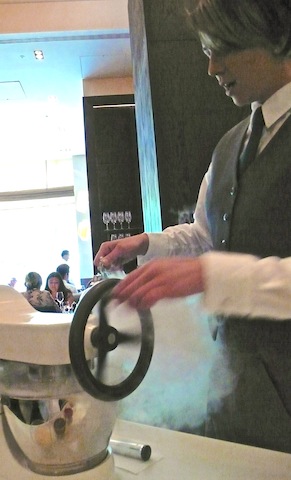
At the end of the meal, having lost all sense of restraint, we ordered vanilla ice cream cones. It was a high-tech version, of course, created at the table by pouring liquid nitrogen into a repurposed Kenwood mixer containing a modest amount of rich English cream. With one hand, our waitress turned the wheel and the paddle attachment churned the cream. With the other she slowly poured in the nitrogen from a carafe. As she did so, cloud after cloud arose from the bowl, and ‘abracadabra’, in that time the cream had frozen. It was a perfect consistency: firm enough to hold its shape in a delicate sugared cone, yet soft enough to decorate with chocolate praline powder. And there’s more. Tiny chunks of fresh nectarine were spooned beforehand into the bottom of each cone to hold drips of cream. They also offered a surprising finish to an already extraordinary childhood treat. It’s a touch that exhibits Blumenthal’s amazing level of emotional intelligence.
.
